Ph.D. Information Systems
![]()
Dr. Ommo Clark completed her Ph.D. from the University of Maryland, Baltimore County (UMBC) and was advised by Dr. Karuna Joshi. Her general research interests are in Data Science, AI/ML and Health Informatics. For her thesis, she worked on the Automating the Detection of Health Narrative project.
Dr. Clark is a lecturer in Morgan State University.
She has a BA in Business Admin and an MSc in Information Systems both from the UK. She has extensive experience working in the software development industry in the UK and Nigeria. Read more about her at linktr.ee/ommo_clark.
Publications
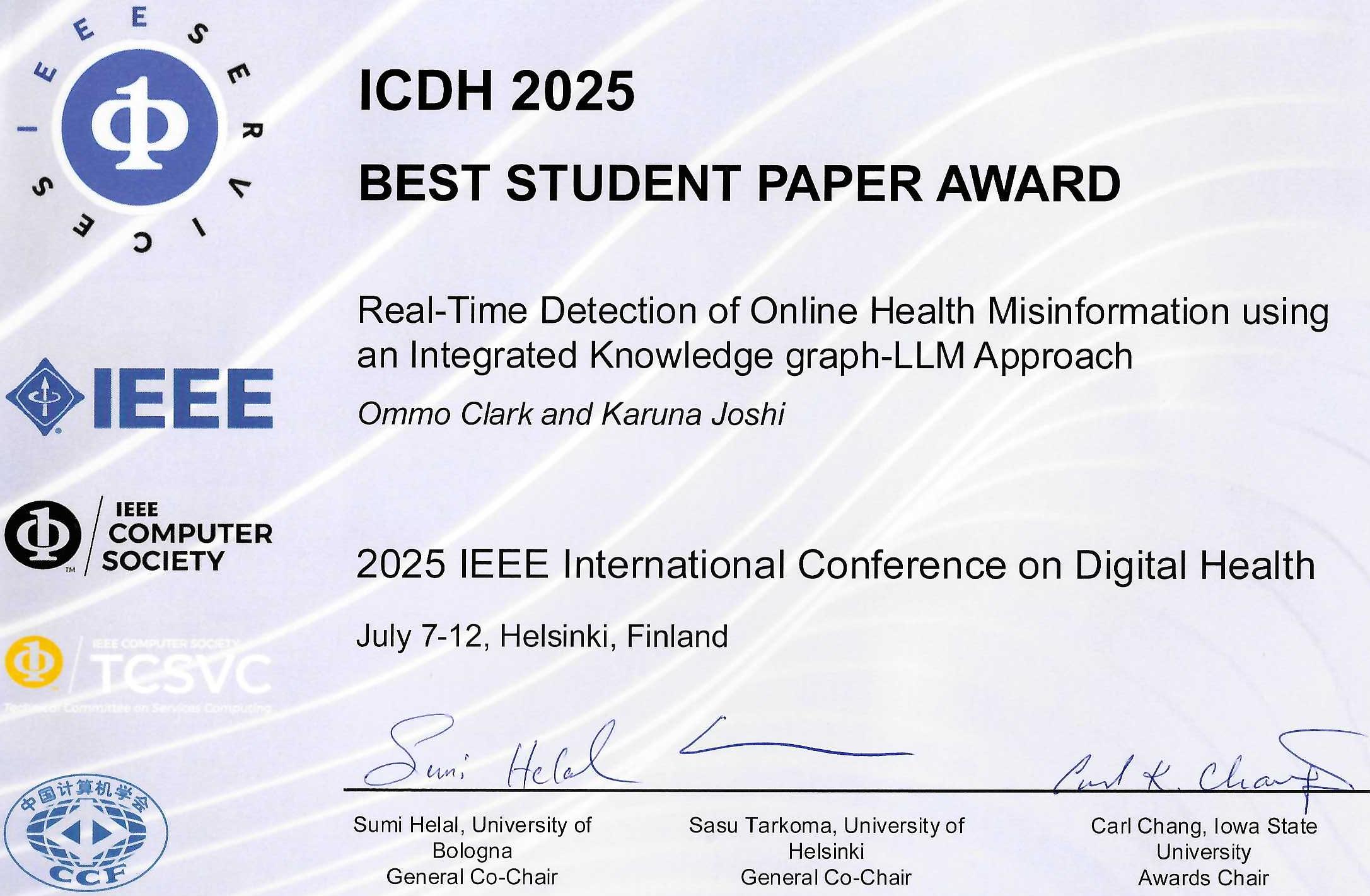
- O. Clark and K. P. Joshi, “Real-Time Detection of Online Health Misinformation using an Integrated Knowledgegraph-LLM Approach“, IEEE International Conference on Digital Health (ICDH) , 2025 at IEEE World Congress on Services 2025, July 2025 [Best Student Paper Award]
- O. Clark and K. P. Joshi, “Evaluating Causal AI Techniques for Health Misinformation Detection“, Causal AI for Robust Decision Making (CARD 2025) Workshop, held in conjunction with 23rd International Conference on Pervasive Computing and Communications (PerCom 2025), March 2025
- O. Clark, K. P. Joshi, and T. Reynolds, “Global Relevance of Online Health Information Sources: A Case Study of Experiences and Perceptions of Nigerians“, AMIA 2024 Annual Symposium, November 2024.
- Ommo Clark, Tera Reynolds, Emmanuel Ugwuabonyi, and Karuna P. Joshi, “Exploring the Impact of Increased Health Information Accessibility in Cyberspace on Trust and Self-care Practices“, The 2024 ACM Workshop on Secure and Trustworthy Cyber-Physical Systems (ACM SaT-CPS 2024), June 2024
Ommo successfully defended her Ph.D. Thesis on 23 Sep 2026.
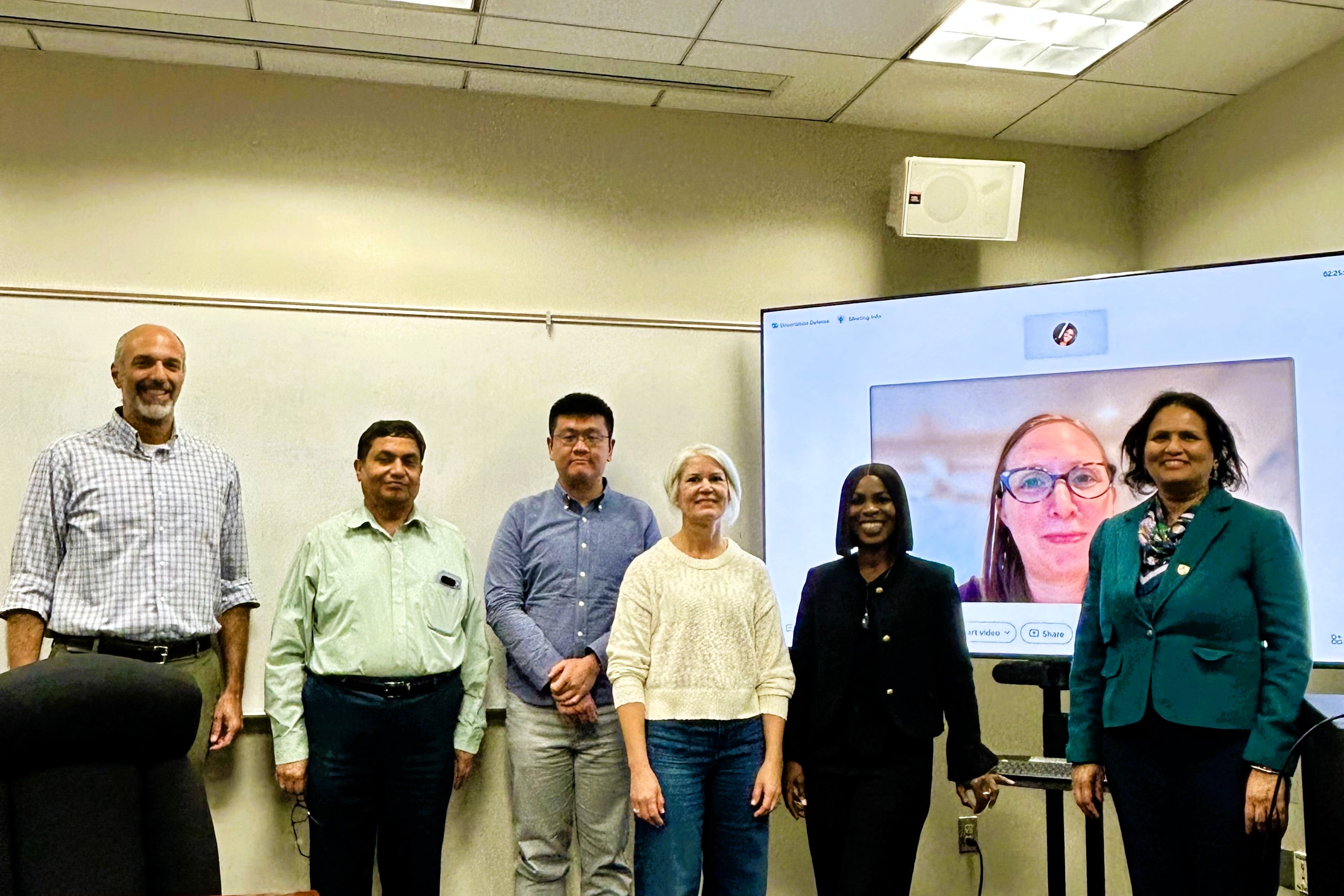
Title: Risk-Aware Credibility Assessment in Online Health Discourse: A Neuro-Symbolic Framework for Reconstructing Narrative Structure and Quantifying Epistemic Divergence and Harm Potential
Committee: Dr. Karuna P Joshi (Chair), Dr. Tera Reynolds, Dr. Andrea Kleinsmith, Dr. Ian Stockwell, Dr. Kai Sun and Dr. Anupam Joshi (CSEE)
Abstract:
The dominant paradigm for computational health misinformation detection assumes that factual incorrectness is the primary vector of harm and that divergence from medical consensus reliably signals risk. This dissertation demonstrates that both assumptions are empirically unfounded. The problem is not that systems detect poorly; it is that they detect the wrong object: they evaluate claims, but readers encounter stories.
This dissertation’s aim is to assess health narratives as wholes, with agents, actions, outcomes, and framing intact, and to measure two properties of the whole that fact-checking cannot reach. Two constructs make the aim precise. Narrative Blindness names systems’ inability to model who acts, what they do, what results, and how it is framed, the features that make health narratives persuasive and actionable. The Risk Irrelevance Principle establishes that a narrative’s departure from medical consensus (epistemic divergence) and the harm that could follow from acting on it (harm potential) are distinct dimensions: across 699 Reddit health narratives, divergence explained under 5% of harm-potential variation, replicated on an independent corpus, showing that neither is recoverable from the other. Together these constructs reframe health misinformation from a factual-error problem to one of contextual safety, formalized as online health safety.
The dissertation presents VERITAS, a neuro-symbolic framework that reconstructs health discourse into Agent-Action-Outcome narrative graphs, quantifies both properties separately, and classifies narratives into four categories for proportionate intervention. On the evaluation corpus, single-axis systems mishandle 39.6% of narratives by construction. This decomposes into two named gaps: an online health equity gap, the 14.4% that is divergent but safe, where over-flagged culturally grounded practices concentrate; and an online health safety gap, the 25.2% that is epistemically aligned yet carries elevated harm potential, passing every divergence check. Both persist across every parameterization examined; their point estimates are those of the computed partition and await expert validation. The dissertation also quantifies the evaluation signal accuracy-labeled benchmarks afford and specifies the risk-annotated resource required.
Credibility in online health discourse is narrative-dependent and consequence-sensitive, emerging not from whether claims are correct but from who acts, what they do, what results, and whether repeating those actions could help or harm.
Ommo’s paper received the Best Student Paper Award at IEEE ICDH 2025
Ommo successfully defended her Ph.D. Proposal on 10 June 2025.
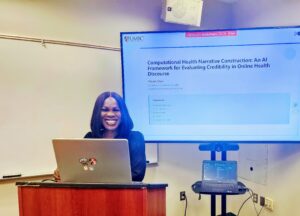
Proposal: Computational Health Narration Construction: An AI Framework for Evaluating Trustworthiness in Online Health Discourse
Committee: Dr. Karuna P Joshi (Chair), Dr. Tera Reynolds, Dr. Ian Stockwell, Dr. Kai Sun, Dr. Anupam Joshi (CSEE)
Abstract:
The rapid proliferation of online health narratives profoundly influences public perceptions and medical decision-making. However, most misinformation detection models focus on isolated factual claims, overlooking the epistemic, narrative, and causal coherence of user-generated stories, resulting in “Narrative Blindness” and “Risk Irrelevance”.
This dissertation proposal introduces Narrative-Cred, an AI-driven framework for computational health narration construction, which systematically reconstructs fragmented online health stories into structured Agent-Action-Outcome (AAO) narratives. By integrating transformer-based narrative segmentation (DistilBERT), biomedical knowledge graph validation (UMLS, SNOMED CT, DrugBank), and causal inference models (CausalBERT, DoWhy), Narrative-Cred enables nuanced, context-sensitive credibility assessment and risk quantification.
Key innovations include the Narrative Ground-Truth Distance (NGTD), a continuous metric quantifying divergence from medical consensus, and the Narrative Risk Score (NRS), a clinically informed prioritization of harmful narratives. The framework is validated on a longitudinal corpus of 16,000 Reddit posts and cross-cultural survey data spanning seven countries. By embedding sociolinguistic narrative theory within modern AI architectures, this research establishes a new paradigm for evaluating the trustworthiness of online health discourse, offering rich, explainable, and clinically relevant assessments that surpass traditional binary classifiers.