Ph.D. Candidate, Information Systems
![]()
Subhankar Chattoraj is a Ph.D. Candidate at the University of Maryland, Baltimore County (UMBC) advised by Dr. Karuna Joshi. His research interests are in Cloud Computing, Healthcare Analytics, Deep Learning, and Machine Learning.
Subhankar received his Master’s in Information Systems from UMBC and Bachelor’s in Electronic and Communication Engineering from India. He has previously worked in R&D at Imaging Endpoints LLC
Publications
- Subhankar Chattoraj and Karuna P. Joshi, “LLM based Knowledge Graph Approach to Automating Medical Device Regulatory Compliance“, 2025 IEEE International Conference on Big Data (BigData), December 2025.
- Subhankar Chattoraj and Karuna P. Joshi, “MedReg-KG: KnowledgeGraph for Streamlining Medical Device Regulatory Compliance“, 2024 IEEE International Conference on Big Data (BigData), Washington, DC, USA, 2024, pp. 3382-3390, doi: 10.1109/BigData62323.2024.10825686.
- Subhankar Chattoraj and Karuna P. Joshi, “Semantically Rich Approach to Automating Regulations of Medical Devices“, IEEE International Conference on Digital Health (ICDH) , 2024 at IEEE World Congress on Services 2024, July 2024
Subhankar successfully defended his PhD Proposal in August 2026
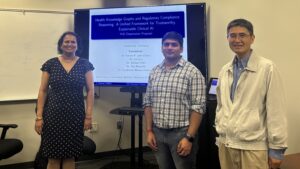
Title: Health Knowledge Graphs and Regulatory Compliance Reasoning: A Unified Framework for Trustworthy Clinical AI
Date: Thursday, August 20, 2026, 11:00am – 1:00pm EST in ITE 404
Committee: Dr. Karuna P. Joshi (Chair), Dr. Kai Sun, Dr. Zhiyuan Chen, Dr. Tera Reynolds and Dr. Ansu Chatterjee (Department of Mathematics and Statistics)
Abstract: Modern healthcare generates vast amounts of information electronic health records, clinical notes, medical imaging, and device data that must be both clinically useful and provably compliant with regulations such as HIPAA and the FDA’s rules for AI-based medical software. Today, these two goals are usually pursued separately; systems built to support clinical decisions are rarely designed to demonstrate regulatory compliance, and compliance systems are rarely grounded in the clinical evidence they are meant to govern. This dissertation argues that these are not two problems but one, and proposes a unified framework, called CKRR, that represents clinical knowledge and regulatory rules within a single, shared knowledge graph.
Building on a research trajectory that includes a knowledge graph for FDA medical device compliance, a large language model system that translates plain-language questions into compliance checks. This dissertation develops four connected components namely, a pipeline for constructing clinical knowledge graphs from patient records and imaging data, a reasoning layer that answers clinical questions using that graph, a regulatory reasoning layer that checks compliance against HIPAA and FDA requirements, and an explainability layer that traces every system output back to its clinical and regulatory justification.
The framework will be validated through an initiative developing digital twins in which patient-specific computational models for neurodegenerative disease research are built using longitudinal MRI data from Alzheimer’s studies. This work aims to show that clinically useful AI and regulation-ready AI can and should be built within the same unified framework.